

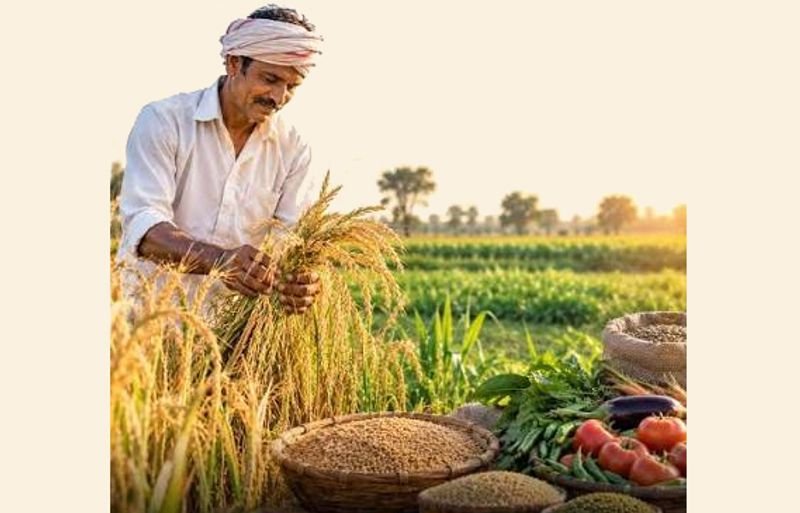
Dr. Banarsi Lal kvkreasi@gmail.com World Food Day is observed every year on 16 October to raise awareness of hunger, challenge despite substantial advances in agricultural production. According to the FAO and its United Nations partner agencies’ *The State of Food Security and food systems. Climate change increases risks associated with heat, irregular rainfall, droughts, floods and changing pest pressures. Farmers need timely weather information, climate-resilient crop varieties, efficient irrigation, soil and water conservation, integrated pest management, improved storage and reliable market access. Diversification into suitable crops, horticulture, livestock and other locally appropriate enterprises can strengthen farm livelihoods and improve the availability of diverse foods. Scientific advice and extension services should be accessible to small and marginal farmers, including women and young people.
India has made substantial progress in food-grain production since the Green Revolution of the 1960s. Early increases after Independence came partly from expansion of the cultivated area; subsequent gains increasingly reflected improved varieties, irrigation, crop nutrition, crop protection, mechanisation, research, extension and supporting infrastructure. India is now a major producer and exporter of several agricultural commodities. However, national food-grain availability does not automatically ensure household-level food and nutrition security. People also need sufficient income, affordable prices, effective distribution systems and access to diverse foods, including pulses, vegetables, fruits, milk, eggs and other nutrient-rich products.Food security is broader than the physical availability of grain. It includes reliable access to sufficient, safe and nutritious food, the ability to utilise that food effectively, and stability of access over time. Affordability is especially important for low-income households. A household may have access to cereals yet still lack a balanced diet because pulses, fruits, vegetables and other nutrient-rich foods are unaffordable or unavailable. Safe drinking water, sanitation, healthcare, education and women’s decision-making power also influence nutrition outcomes. Food security must therefore be addressed at individual, household, community, regional and national levels, with particular attention to children, older people and other vulnerable groups.
Agricultural development must protect the natural resource base on which food production depends. Regenerative and other sustainable farming approaches, selected according to local conditions and supported by evidence, can improve soil structure, maintain soil organic matter, protect biodiversity, reduce erosion and increase the efficient use of water and nutrients. Crop rotation, cover cropping, integrated nutrient management, conservation agriculture and integrated pest management may contribute to more resilient production systems when adapted to local agroecological conditions. Innovation should complement farmers’ experience and local knowledge, and its benefits should be assessed in terms of productivity, profitability, nutrition and environmental performance.Reducing food loss and waste can further improve food-system efficiency. Better harvesting practices, grading, suitable packaging, cold-chain facilities, storage, processing and transport can help preserve perishable produce and increase farmers’ returns. Local processing and value addition can create employment, reduce seasonal losses and make fruits, vegetables and other nutritious foods available in different forms. These interventions should be supported by food-safety standards, quality control and clear labelling so that consumers can make informed choices.Achieving Zero Hunger requires collaboration across sectors. Governments can strengthen social protection, nutrition programmes, agricultural research, rural infrastructure and fair access to markets. Universities and extension institutions, including Krishi Vigyan Kendras, can help farmers adopt locally appropriate technologies and improve post-harvest management. Businesses can invest in responsible supply chains, while communities, schools and households can promote healthy diets and prevent avoidable food waste. Efforts should be inclusive, evidence-based and attentive to the needs of smallholder farmers and disadvantaged groups.World Food Day reminds us that food security is a shared responsibility. The challenge is not simply to produce more food, but to ensure that everyone can access safe, affordable and nutritious diets without undermining the natural resources needed by future generations. By combining scientific innovation with traditional knowledge, sustainable farming, effective public policies, responsible consumption and collective action, we can move towards healthier lives and more resilient food systems.
The author is Dr. Banarsi Lal, Chief Scientist and Head, Krishi Vigyan Kendra (KVK) Reasi, Sher-e-Kashmir University of Agricultural Sciences and Technology of Jammu (SKUAST-J), Jammu and Kashmir.
