

InfographicsCompanies
Market Size (2026)
USD 459.0 Mn
Forecast (2036)
USD 1116.8 Mn
CAGR (2026 to 2036)
9.3%
How big is Heart-Healthy Medical Meal Market in 2026?
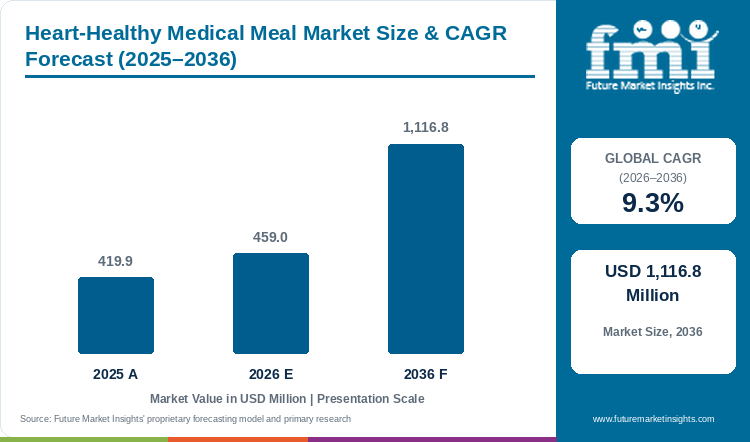
Demand for heart-healthy medical meals is projected to expand at 9.3% CAGR between 2026 and 2036. Industry value grows from USD 419.9 million in 2025 to USD 459.0 million in 2026 and is projected to reach USD 1,116.8 million by 2036.
Heart-healthy medical meals are gaining preference as consumers and care providers require prepared food having controlled sodium and saturated-fat content. These meals provide fixed portions after discharge or during dietary care, which reduces home preparation for consumers and caregivers. FMI estimates the market to increase from USD 419.9 million in 2025 to USD 459.0 million in 2026 and reach USD 1,116.8 million by 2036, expanding at 9.3% CAGR during 2026 to 2036. In August 2024, the U.S. FDA issued draft Phase II sodium-reduction targets for 163 packaged and prepared food categories.[1] Visible nutrient limits, familiar taste and dependable delivery are expected to support regular use and repeat orders.
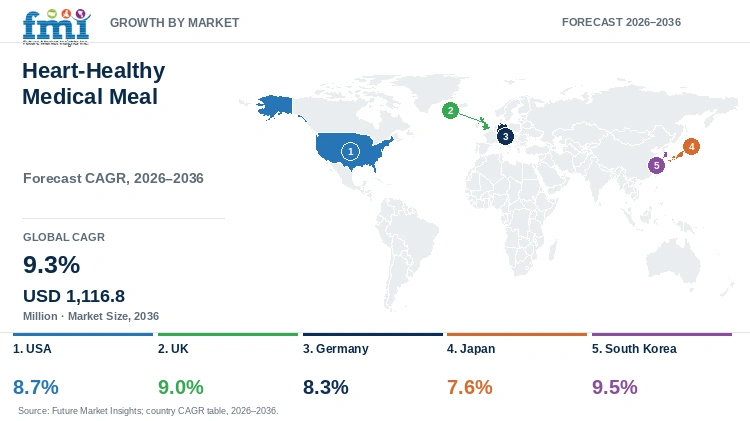
Payment routes and prepared-food habits are creating different adoption conditions across countries. South Korea is projected to expand at 9.5% CAGR during 2026 to 2036, while the USA is forecast at 8.7%. Digital ordering and prepared-food consumption are likely to improve direct access in South Korea, whereas payer referrals and post-discharge pathways support demand in the USA. CMS reported that 48% of Medicare beneficiaries used Medicare Advantage in its 2025 edition.[2] Based on FMI analysis, this covered population can widen eligible meal access in the USA, while localized recipes and convenient ordering can upkeep repeated purchase in South Korea.
Heart-Healthy Medical Meal Market Size & CAGR Forecast (2025-2036)
Global heart-healthy medical meal market value by year, with forecast growth rate
Year
Basis
Market value (USD million)
2025
Actual
419.9
2026
Estimate
459.0
2036
Forecast
1,116.8
CAGR, 2026 to 2036
9.3%
Key Takeaways
- Rising need for sodium-controlled food along with convenient home delivery is expected to support heart-healthy medical meal demand.
- Based on meal pattern, low-sodium DASH meals are projected to account for 48.4% in 2026, owing to clear sodium limits.
- By payer, Medicare Advantage and managed care are estimated to hold 43.9% in 2026, supported by organized member access.
- In 2026, medically tailored meal programs are expected to lead delivery model with 58.5% share, owing to referral-linked delivery.
- South Korea is projected to register 9.5% CAGR through 2036 owing to rapid ageing, digital ordering and prepared-food adoption.
- Notable companies include Mom’s Meals, BistroMD, ModifyHealth, Magic Kitchen, Territory Foods, Performance Kitchen, Sunbasket, and Snap Kitchen.
Analyst Perspective
“I see demand moving towards meals having clear sodium limits, familiar taste and simple access through care programs. Providers widening local menus and dependable delivery will find better opportunities for regular use across older households.”
– , Principal Consultant, Future Market Insights.
How is the heart-healthy medical meal market segmented?
Heart-healthy medical meal market is segmented across five commercial axes and region: meal pattern, payer, delivery model, end user, sales channel, and region. In 2026, low-sodium DASH meals are projected at 48.4%, Medicare Advantage and managed care at 43.9%, medically tailored meal programs at 58.5%, seniors at 56.6%, and online or DTC at 42.8%.
Heart-healthy medical meal market is segmented by meal pattern, payer, delivery model, end user, sales channel, and region.
Why do low-sodium DASH meals hold notable meal pattern demand?
Low-sodium DASH meals are expected to hold 48.4% of meal pattern revenue in 2026, supported by measurable sodium targets.
Meal type
Share (2026)
Low-sodium DASH meals
48.4%
Other segments combined
51.6%*
Total
100.0%
Metric
Value
Global CAGR (2026-2036)
9.3%
Leading segment
Low-sodium DASH meals
Low-sodium DASH meals are gaining preference as they provide a clear food pattern for consumers requiring controlled sodium intake. The National Heart, Lung, and Blood Institute retained daily sodium targets of 2,300 mg and 1,500 mg in its February 2026 update.[3] FMI benefits in 2025, while 84% provided food allowances for chronically ill enrollees.[4] This enrolled population provides a wider base for post-discharge meals and telehealth-linked nutrition support. Apart from that, organized referrals can make ordering easier for members. However, plan design, eligibility and actual use of the benefit will continue to influence adoption.
- Medicare Advantage and managed care are estimated to hold 43.9% of payer revenue in 2026 because plans can organize eligible demand.
- Simple eligibility, referral completion and convenient ordering are expected to support the preference for managed care programs.
How do medically tailored meal programs meet delivery needs?
Medically tailored meal programs are projected to capture 58.5% of delivery model demand in 2026, driven by verified clinical need.
Medically tailored meal programs are developed according to a documented health condition and provide organized home delivery for eligible users. In September 2026, a House committee approved a proposed six-year Medicare pilot involving at least 40 hospitals and two daily home-delivered meals.[5] This type of program enables hospitals and plans to provide meals according to medical requirements, often functioning alongside post-angioplasty recovery nutrition pathways. Owing to this connection between referral, meal selection and delivery, medically tailored meal programs are expected to witness higher preference during the forecast period.
- Medically tailored meal programs are expected to represent 58.5% of delivery-model revenue in 2026 through referral-linked fulfillment.
- Meal selection, nutrition support and home delivery under the same referral record is likely to improve program access.
Why do seniors remain relevant within the end user category?
With an estimated 56.6% share in 2026, seniors lead the end user category, underpinned by chronic conditions and cooking constraints.
Seniors are facing higher need for prepared nutrition as chronic conditions, mobility limitations and difficulty in food preparation can occur together. The U.S. Census Bureau reported in August 2026 that 73% of Americans aged 65 or older had at least two chronic conditions during 2016 to 2019.[6] Heart-healthy meals can be selected by users or caregivers alongside home healthcare products and delivered according to a weekly schedule. Apart from that, covered benefits, familiar meals and easy ordering are anticipated to support adoption among older users.
- Seniors are projected to hold 56.6% of end user revenue in 2026 because clinical need can overlap with preparation difficulty.
- Caregiver ordering and familiar meal formats are likely to make weekly food preparation easier for older users.
Which conditions keep online ordering relevant in sales channels?
Online or DTC channels are anticipated to contribute 42.8% of sales channel revenue in 2026, owing to direct menu selection.
Online ordering is enabling users to compare, select and receive heart-healthy prepared meals without depending on nearby store availability. ModifyHealth specifies no more than 700 mg sodium and less than 6 grams saturated fat per heart-friendly meal.[7] Such nutrient information helps consumers in selecting ready-to-eat food options according to their requirement before checkout. In addition, recurring subscriptions and weekly menu control are expected to upkeep preference for the online or DTC sales channel.
- Online or DTC is likely to capture 42.8% of sales-channel revenue in 2026 because users can manage recurring orders directly.
- Wider menu visibility and flexible weekly selection are expected to maintain preference for direct online ordering.
What are the drivers, restraints, and opportunities in the heart-healthy medical meal market?
In the heart-healthy medical meal market, the key driver is sodium-aware nutrition, the key restraint is access friction, and the key opportunity is integrated care delivery.
- Driver: Updated diet guidance supports meals with visible sodium and saturated-fat limits.
- Restraint: Eligibility, recurring cost, taste preference, and missed deliveries can stop repeat use.
- Opportunity: Payer and hospital programs can combine meal access with post-discharge nutrition support.
Updated Guidance Supports Meal Design
High sodium consumption is one of the primary factors that is boosting demand for meals having controlled nutrient limits. WHO reported in May 2026 that only 28% of the world population lives in countries having mandatory sodium-reduction policies.[8] This leaves a large population depending on food labels, product reformulation, and reduced salt packaged foods for controlling intake. Prepared meals provide fixed portions and repeated sodium limits, due to which adoption is anticipated to rise among users requiring regular heart-health nutrition.
Access Friction Limits Repeat Use
High delivered meal price and limited benefit access are the key factors that can hamper adoption of heart-healthy medical meals. CMS reported that out-of-pocket health spending increased by 5.9% to USD 556.6 billion during 2024.[9] Delivered meals are paid directly by many households where a covered benefit is not available, due to which repeated weekly orders can become difficult, especially when medical food categories lack standardized national reimbursement codes. In addition to this, eligibility checks and missed deliveries can further restrict regular use of these meals.
Care Pathways Create Expansion Space
Use of nutrition support after hospital discharge is creating growth prospects for heart-healthy medical meal providers. Food is Medicine Coalition members reported delivering 14.4 million medically tailored meals during 2025.[10] Hospitals and health plans can provide these meals where patients require regular dietary care alongside enteral nutrition support but cannot prepare suitable food at home. Therefore, providers having suitable menus, wider service coverage and dependable delivery are expected to find new opportunities across discharge and home-care programs.
Which country CAGRs are profiled in the heart-healthy medical meal market?
Country
CAGR
USA
8.7%
UK
9.0%
Germany
8.3%
Japan
7.6%
South Korea
9.5%
How do country-level CAGRs compare in the heart-healthy medical meal market?
As per the analysis from FMI, country growth rates differ through 2036 because reimbursement frameworks, aging demographics, and prepared-food delivery ecosystems are not uniform across markets. South Korea and the UK lead projected growth above 9.0 per cent, while Japan and Germany follow distinct dietary and care structures.
- USA demand is shaped by payer-linked meal benefits and post-discharge pathways.
- The UK combines older consumers with retail and local-care purchasing routes.
- Germany relies on consumer payment and care-provider distribution more than a single national benefit.
- Japan requires portion, taste, and format adaptation for an older population.
- South Korea combines rapid ageing with broad use of prepared foods and digital ordering.
Full report country CAGRs cover: North America; Latin America; Western Europe; Eastern Europe; East Asia; South Asia and Pacific; Middle East and Africa.
Country-wise Analysis
- By 2036, the USA is projected to grow at 8.7% CAGR, owing to payer-linked benefits and post-discharge meal access. The American Heart Association reported in its 2025 statistical update that cardiovascular disease accounts for over 931,000 deaths annually in the United States, maintaining substantial clinical need for dietary intervention.[11] This expanding payer and clinical base can support nutrition benefits where health plans include frozen ready meals for post-discharge recovery. However, eligibility and referral completion will influence actual adoption. Sodium-controlled menus and dependable national delivery are expected to drive demand in the country.
- The UK heart-healthy medical meal outlook is anticipated to advance at 9.0% CAGR, attributable to cardiovascular care needs and local-service purchasing. England recorded about 1.9 million people with a general-practice diagnosis of coronary heart disease in the financial year ending March 2025.[12] This is creating need for convenient meals having clear sodium and saturated-fat limits. Direct delivery and care-linked purchasing will support adoption; however, familiar menus and dependable chilled distribution are likely to influence repeat ordering.
- Heart-healthy medical meal demand in Germany is forecast to rise at 8.3% CAGR, driven by population ageing and home-care requirements. Destatis projects that one quarter of Germany’s population will be aged 67 or older by 2035, compared with one fifth in 2024.[13] This shift is expected to boost demand for prepared nutrition where shopping and cooking becomes difficult. However, payment remains divided among households, care providers and local programs. Familiar meals, visible nutrient limits and simple ordering will further support adoption.
- In Japan, adoption of heart-healthy medical meals is estimated to expand at 7.6% CAGR through 2036, influenced by ageing and nutrition policy. Japan’s health ministry reported that 43 participating businesses pursued measurable healthy-food commitments during fiscal 2024, including sodium-reduction activity.[14] FMI data suggests that these meals need to match local dishes, portions and textures as sodium reduction can change familiar taste. Local menu development is therefore expected to drive regular adoption.
- South Korea is estimated to post 9.5% CAGR over the forecast period, supported by rapid ageing and established digital food ordering. Statistics Korea reported that the elderly population aged 65 or older reached 20.1% of the total population in 2024, officially entering a super-aged society.[15] This is likely to raise demand for convenient meals among smaller and older households. Also, usage of prepared-food delivery will support access, while localized recipes and clear sodium limits are expected to influence repeated purchase.
Who are the notable companies in the heart-healthy medical meal market?
Mom’s Meals, BistroMD, ModifyHealth, Magic Kitchen, Territory Foods, Performance Kitchen, Sunbasket, and Snap Kitchen are notable companies profiled in this market.
Heart-healthy medical meal market includes payer-linked nutrition providers, condition-specific meal companies and wider prepared-meal platforms. Mom’s Meals, ModifyHealth and Performance Kitchen are focused on meals supplied through clinical and health-plan pathways. In the FMI report, competitive position is connected with documented nutrition limits, referral integration, and fulfillment reliability. BistroMD and Magic Kitchen are serving consumers through condition-oriented direct ordering. Apart from that, Territory Foods, Sunbasket and Snap Kitchen use digital platforms for prepared-meal selection. Companies are widening menu choices, publishing nutrition limits and expanding delivery reach in order to cater to consumers, caregivers and care providers using different purchasing routes.
- Payer-integrated medical nutrition: Mom’s Meals, ModifyHealth, and Performance Kitchen connect meals with health-plan or provider pathways.
- Condition-specific DTC: BistroMD and Magic Kitchen provide heart-health or lower-sodium consumer programs.
- Prepared-meal platforms: Territory Foods, Sunbasket, and Snap Kitchen compete through digital access and ready-to-eat convenience.
Competitive Benchmarking: Heart-Healthy Medical Meal Market
Company
Nutrition tailoring
Referral integration
Heart-focused meals
Reach
Mom’s Meals
High
High
High
High
BistroMD
High
Low
High
Medium
ModifyHealth
High
High
High
High
Magic Kitchen
Medium
Low
Medium
Medium
Territory Foods
Medium
Low
Low
Medium
Performance Kitchen
High
Medium
High
Medium
Sunbasket
Medium
Low
Low
High
Snap Kitchen
Medium
Low
Low
Medium
High represents wider documented capability, Medium represents selected documented capability and Low represents limited documented capability. These ratings are based on available company information and do not represent company quality or market ranking.
Key Developments in the Heart-Healthy Medical Meal Market
- In April 2026, Sunbasket documented app-based weekly selection for fully prepared single-serving meals.[16] Easy meal selection is expected to support consumers requiring low-preparation food.
- In March 2026, Mom’s Meals reported donating 59,863 medically tailored meals during 2025, nearly twice its stated goal.[17] This activity shows the company ability to supply meals beyond individual subscription demand.
- In January 2026, Snap Kitchen reported delivery coverage in more than 30 U.S. states and availability through more than 40 Southwest Whole Foods Market locations.[18] Wider delivery and retail presence is likely to support prepared-meal access.
Key Players in the Heart-Healthy Medical Meal Market
Payer-integrated medically tailored meal platforms
- Mom’s Meals
- ModifyHealth
- Performance Kitchen
Condition-specific direct-to-consumer meal providers
- BistroMD
- Magic Kitchen
Wellness-oriented prepared meal platforms
- Territory Foods
- Sunbasket
- Snap Kitchen
Heart-Healthy Medical Meal Market – Report Scope
Coverage field
Report scope
Market breakdown
Meal pattern, payer, delivery model, end user, sales channel, and region.
Quantitative units
USD million.
Market definition
Revenue from fully prepared meals intentionally formulated for cardiovascular health or cardiovascular risk management. Meal kits, groceries, supplements, and separately billed counseling are excluded.
Regions covered
North America; Latin America; Western Europe; Eastern Europe; East Asia; South Asia and Pacific; Middle East and Africa.
Countries covered
USA, UK, Germany, Japan, South Korea, and additional countries in the full report.
Key companies profiled
Mom’s Meals, BistroMD, ModifyHealth, Magic Kitchen, Territory Foods, Performance Kitchen, Sunbasket, Snap Kitchen.
Forecast period
2026 to 2036.
Approach
The Future Market Insights report covers supplier activity, segment structure, delivery routes, and country adoption conditions within the stated market boundary.
